Flipkart
2025
Reducing cart abandonment at scale
Redesigning the checkout funnel for 500M+ users
Industry
E-commerce
My role
Product designer
Platform
Mobile
Outcome
48% improvement in the cart performance. Realistically increase in the U2O (Units to Order) from 1.2 to 1.8. (Part of A/B testing)
Context & the problem
What is this?
Flipkart is India's largest e-commerce platform with 500M+ registered users. Despite the scale, a core retail metric was significantly underperforming: Units per Order (U2O) — the average number of items a customer purchases per transaction sat at 1.2. The APAC e-commerce average is approximately 3. That's a 60% gap.
What was broken?
For a platform of Flipkart's size, even a fractional improvement in U2O translates to hundreds of crores in incremental GMV. The problem it was that the platform wasn't effectively nudging users toward complementary purchases at the right moment in their journey.
Challenge
How might we leverage bundling and cross-selling opportunities more effectively — at the right touchpoints in the purchase flow — to bring Flipkart's U2O closer to the APAC e-commerce average, without disrupting the primary purchase intent?
Role & constraints
My role
{Product Designer} : Led secondary research and competitive benchmarking. Developed the ABR (Attitude-Behaviour-Relationship) framework for the project. Owned ideation, wireframing across 4 design directions. Produced final hi-fi designs for all concepts. Presented work to mentors and product stakeholders
Team
{Mentors}: Naveen, Shabir, Kirupali
{Platform}: Flipkart iOS app
{Scope}: Cart, PDP, Post-ATC touchpoints
Timeline
9 Weeks {including side projects at Flipkart}
Constraints
Flipkart's catalogue spans radically different categories — any bundling logic needed to work across fashion, electronics, grocery, home. I could not disrupt the primary purchase funnel — nudges had to be opt-in, skippable. Internship timeline — research, design, and presentation compressed into one summer.
Research & discovery
This is what we knew going in
Flipkart's U2O of 1.2 was roughly 60% below the APAC benchmark of ~3. The cart experience had three specific usability problems: dynamic pricing was creating confusion, the "View all offers" CTA was not prominent enough, and there was no motivation architecture to encourage users to add more products.
What I did
Based on the secondary data, stakeholder interviews and primary research with users, I streamlined my tasks into 4 themes.
Theme 1
Secondary research and industry benchmarking on e-commerce U2O drivers
Theme 2
Deep competitive analysis of Amazon India and Myntra across the full purchase flow (Home → Search → PLP → PDP → Post-ATC → Cart).
Theme 3
Mapped the psychological principles driving purchase behaviour (attitude-behaviour relationship literature).
Theme 4
Developed the ABR Framework — a proposed model mapping design levers (personalisation match, promotional impact, visual aesthetics, social proof) to the attitude-behaviour pathway.
Competitor analysis
I benchmarked Flipkart against Amazon, Myntra, Lazada, Noon and Namshi across key parameters: personalised recommendations, curated product listing, cart experience, and bundled offerings.
Amazon.in
Suggestions on home based on items in cart
Creating urgency with limited time deals
Frequently bought together
Subscription model to retain customers
Myntra
Bundling products to sell the look
Suggestions based on my future behaviour
Fitting recommendation based on profiles
One item from Special deals - a good balance
What we found
Insight 1
The mindset shifts at Add to Cart.
Once a customer decides to purchase, they move from exploration to execution mode. This is the highest-intent moment — and the most underutilised for cross-selling.
Insight 2
Amazon wins on personalisation depth.
Rufus AI combo suggestions, automatic size recommendations, Subscribe & Save, and post-ATC overlay with 4 distinct recommendation categories — all rooted in purchase history.
Insight 3
Myntra wins on aspiration bundling.
Instead of selling individual products, Myntra sells looks and setups — "Find the Perfect Match," "Your Next Favourites." It bundles context, not just items.
Insight 4
Neither competitor has solved Shared Cart
A significant gap for multi-person households, a common Indian buying context.
Defining the direction
Principles for digital transformation
Intent-aware nudging
Principle 1
Interventions must respect where the user is in the funnel. Don't interrupt browse mode with hard sells.
Cognitive ease over choice overload
Principle 2
Bundles should reduce decisions, not add them. Pre-selected, curated combinations only.
Savings clarity
Principle 3
Every nudge must make the financial benefit immediately legible.
Category-adaptive framing
Principle 4
"Complete the Look" for fashion, "Complete the Setup" for electronics, "Equip Your Kitchen" for appliances. The language must match the mental model.
Skippability as trust
Principle 5
Every nudge must have a clear exit. Forced cross-selling creates resentment.
What we decided not to do
Rejected pop-up overlays mid-browse (interrupts exploration mode)
Rejected generic "You may also like" recommendations without personalisation hook
Rejected single recommendation widget — the problem needed a system, not a single touchpoint
Thought vs Design response
When customer decides to purchase a product, the mindset shifts from exploration to execution. I mapped the possible customer thoughts with a possible design response.
Customer thought
Design response
I don’t want to miss anything
Don’t forget these essential add-ons
Is this the best deal I can get?
Add one more item to get ₹150/- off
Others might have made smart combos
Most buyers paired it with these items
I’ll just get what I came for
This small extra items improves your experience
I’m done shopping, don’t bother me now
Offering minimal, non-intrusive suggestions with savings clarity
Design process
Exploration — 4 directions
Direction 1
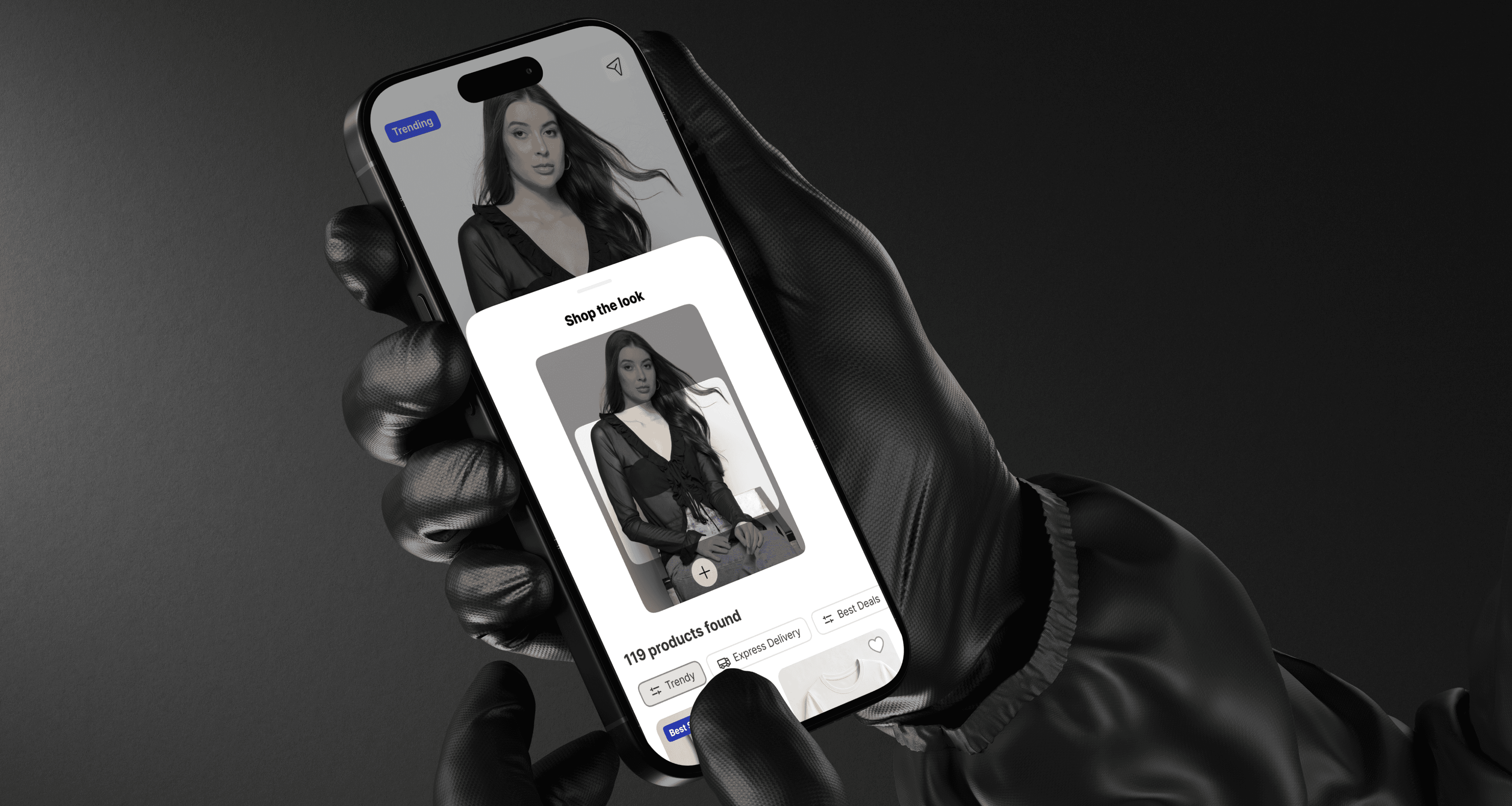
Shop the Look
Direction 2
Shared Cart
Direction 3
Bottom Sheet Nudge (Post-ATC)
Direction 4
Visual Enhancements in Cart
Key design decision — why 4 directions
U2O is a funnel-wide problem. A single widget at one touchpoint would capture only a fraction of the opportunity. The system works because each direction targets a different moment: PDP (pre-cart), Post-ATC (decision moment), Cart (pre-checkout).
Attitude - Behaviour relationship (ABR) framework
The ABR framework defines how an attitude towards any action {in this case online shopping} have significant positive relationship with a decision making {in this case online purchase decision}.
Repeated expression or reports of attitudes
Attitude accessibility
Confidence
Personalisation match
External/internal motivation
Promotional impact
Visual playfulness/aesthetics
Social proof
Behaviour relevance of attitudes
Attitude stability
Attitude - Behaviour (Positive)
Smart recommendation system
A proposed software algorithm, designed to provide hyper-personalised product recommendations.
Recommendation system
Profile based
Location + Season
Time of the day
A comfortable blanket
Myself
North India / Winter
Evening
South India / Winter
Spouse
Kid
Goals of this framework
01. Improve the accuracy
02. Increase the relevance
03. Better UX for recommendations
Cross-selling
+
Up-selling
Final designs
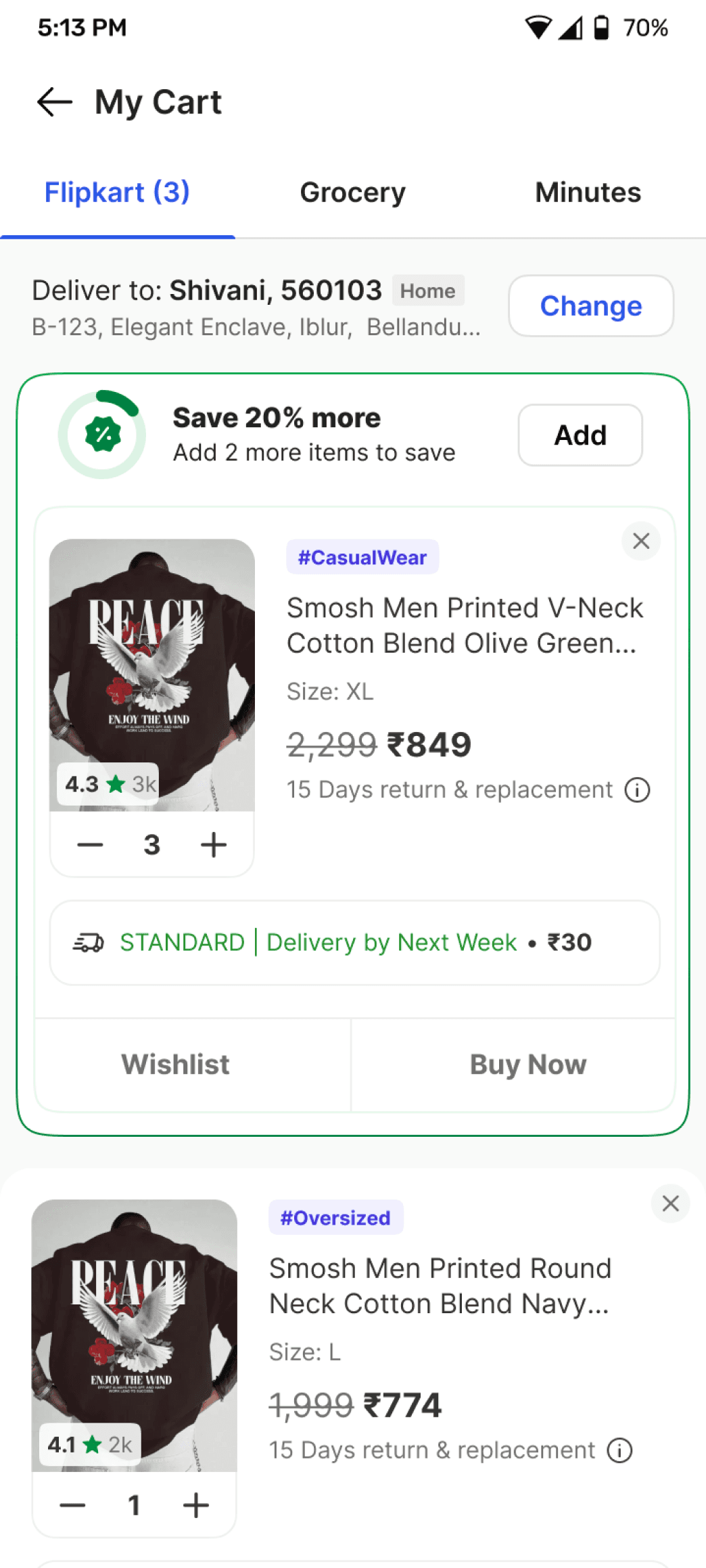
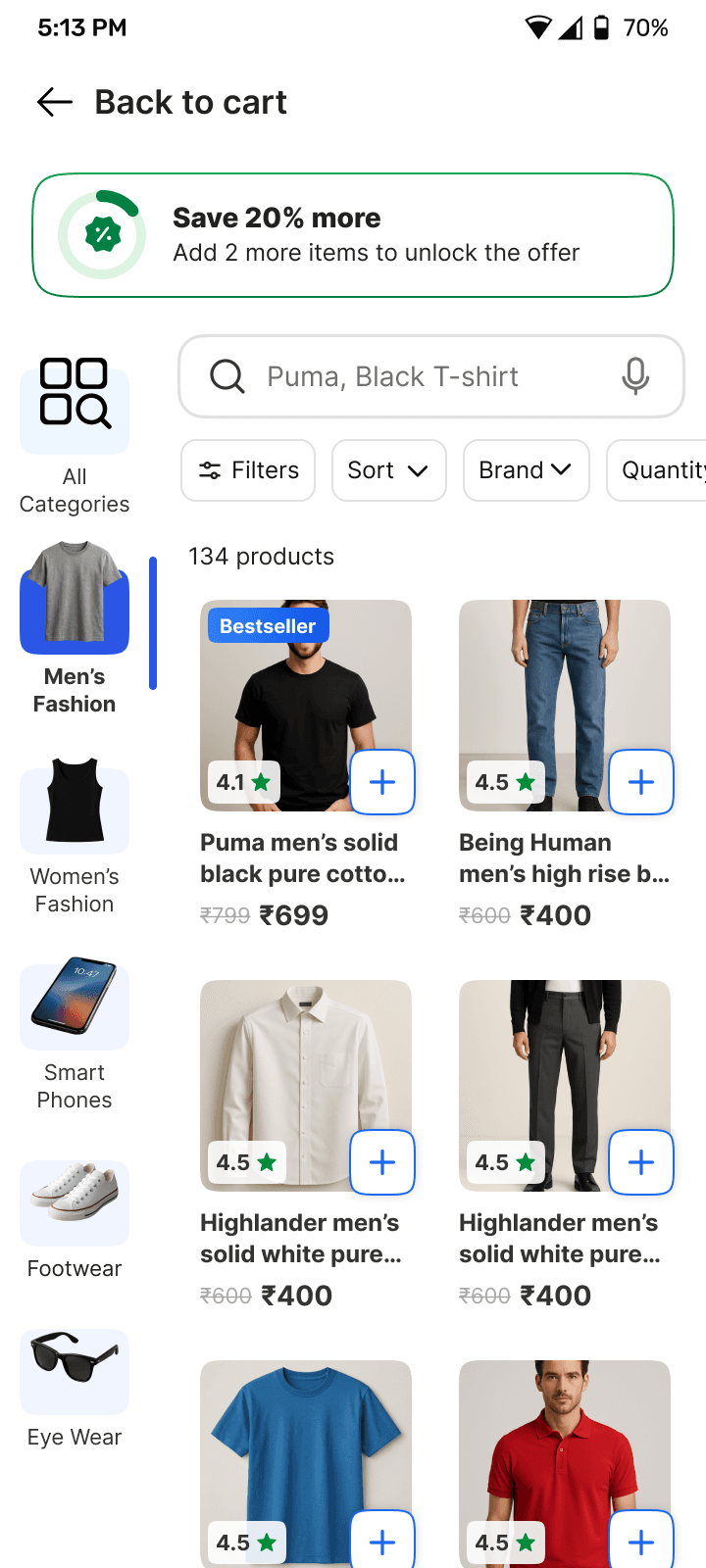
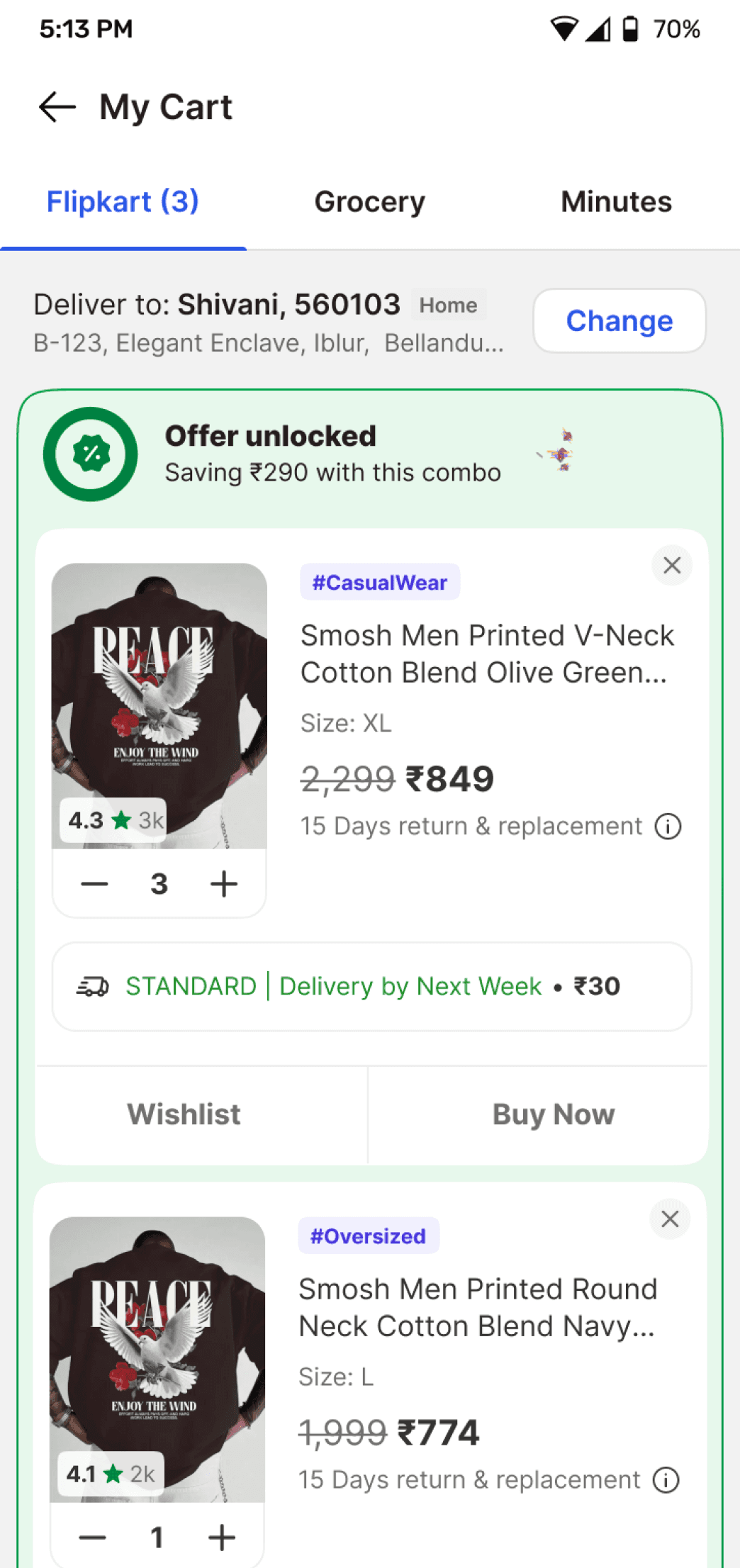
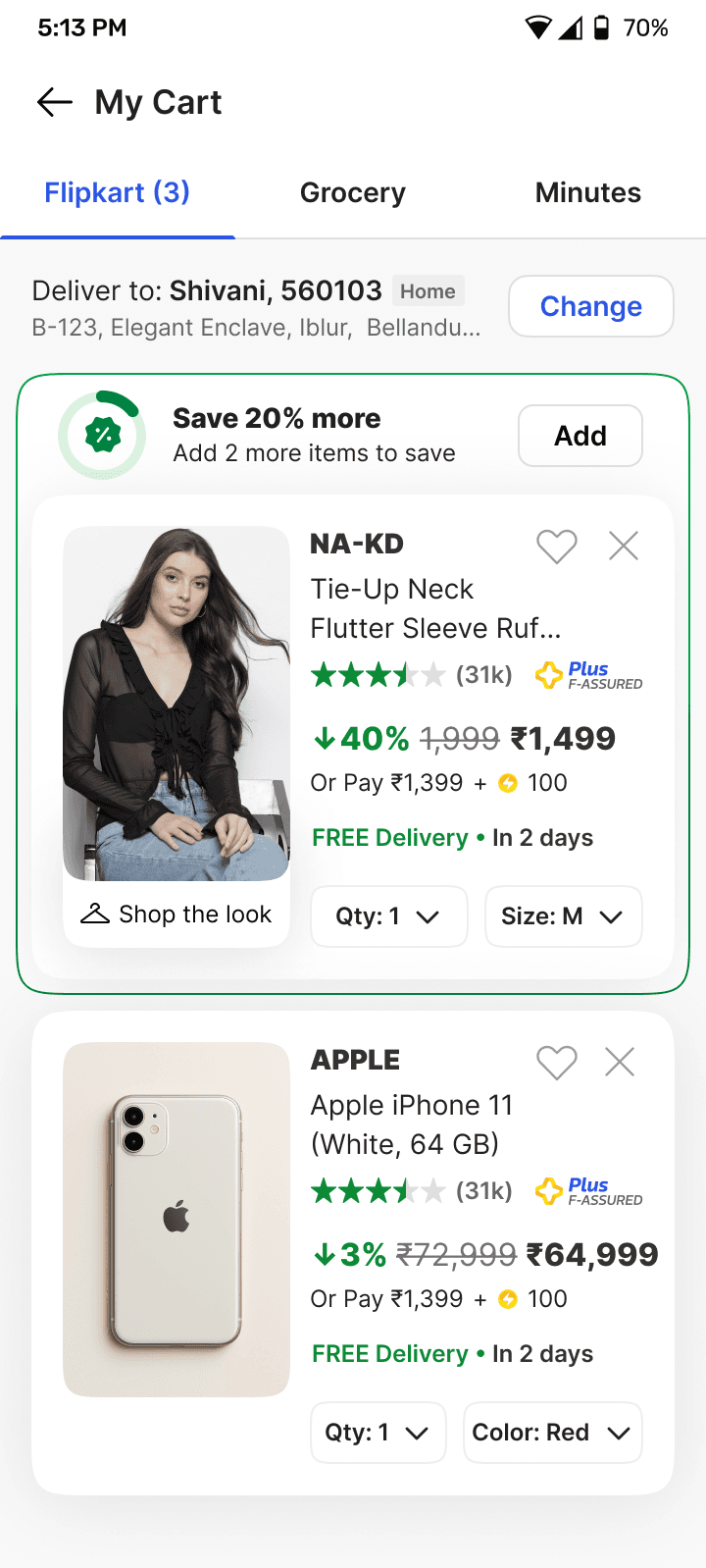
Bundle products to activate savings.
The applicable products in the cart have a clear nudge to pair them with other products and activate the savings.
Cart and offer listing page
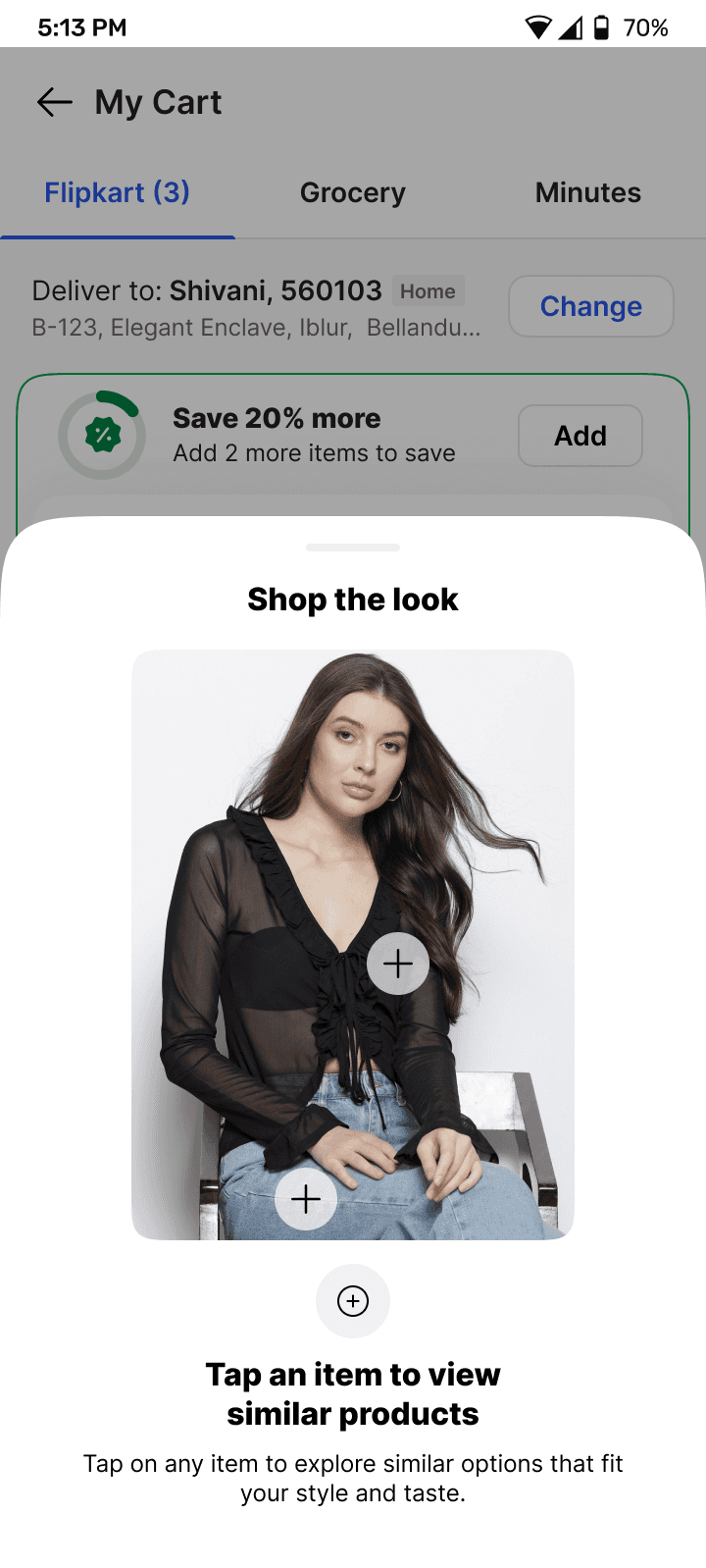
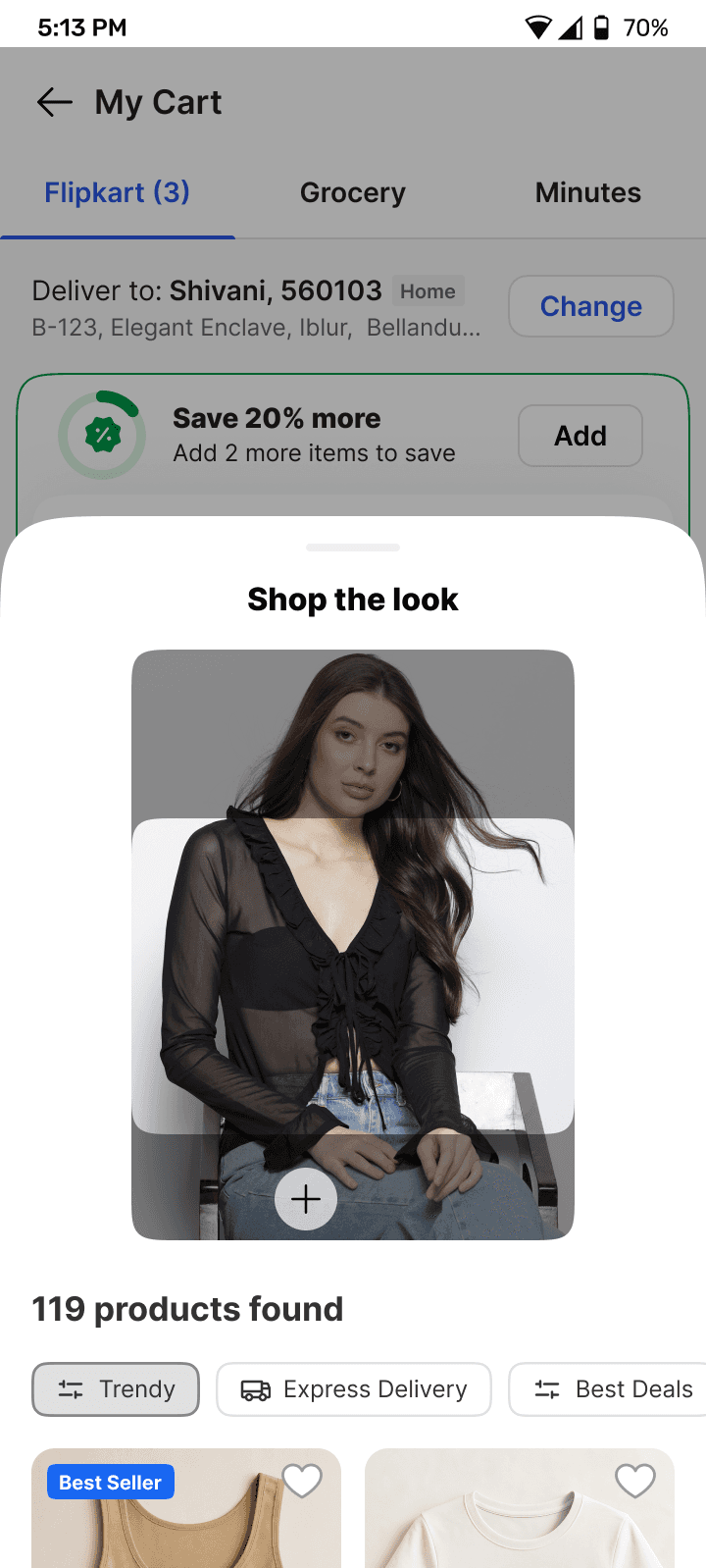
Visual cues to customise products based on smart recommendations.
Especially applicable for fashion category. Users can visually select the part of a picture, referred to as a product {t-shirt, jeans, etc.} and choose a desired alternative.
With Gen AI, users can replace the model with their photo and virtually try the products before making a purchase.
Cart and Shop the look
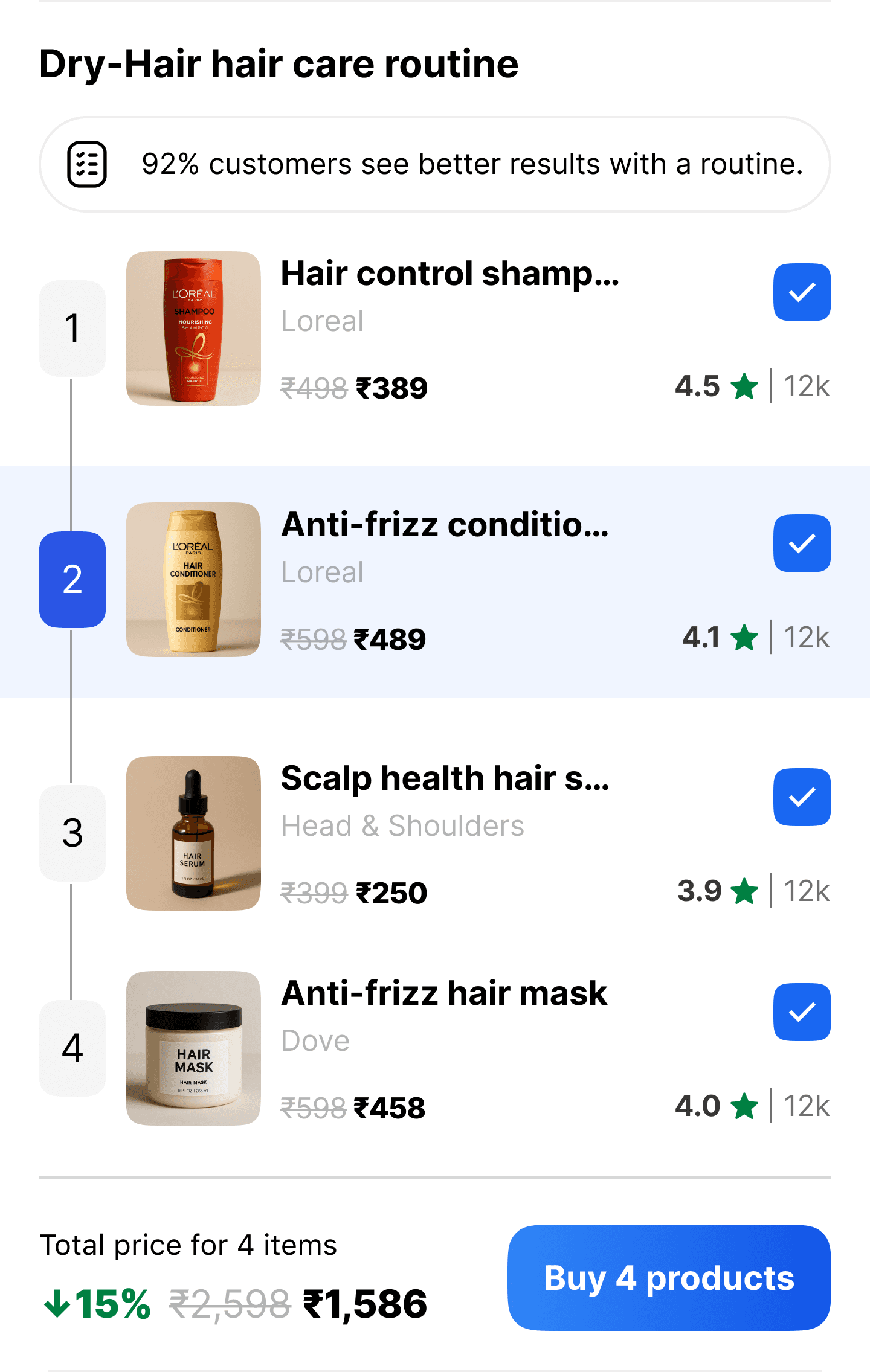
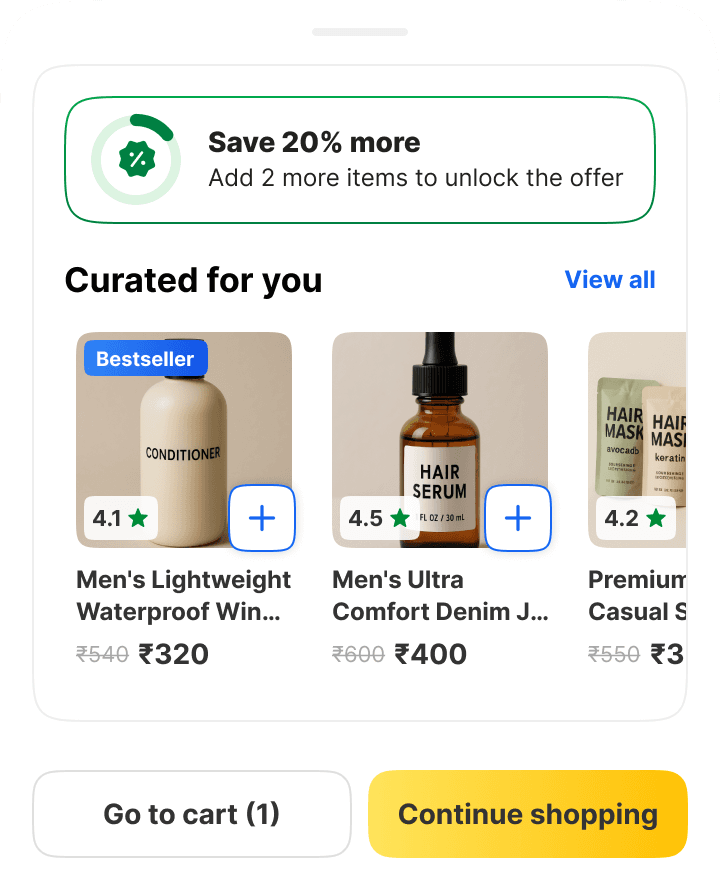
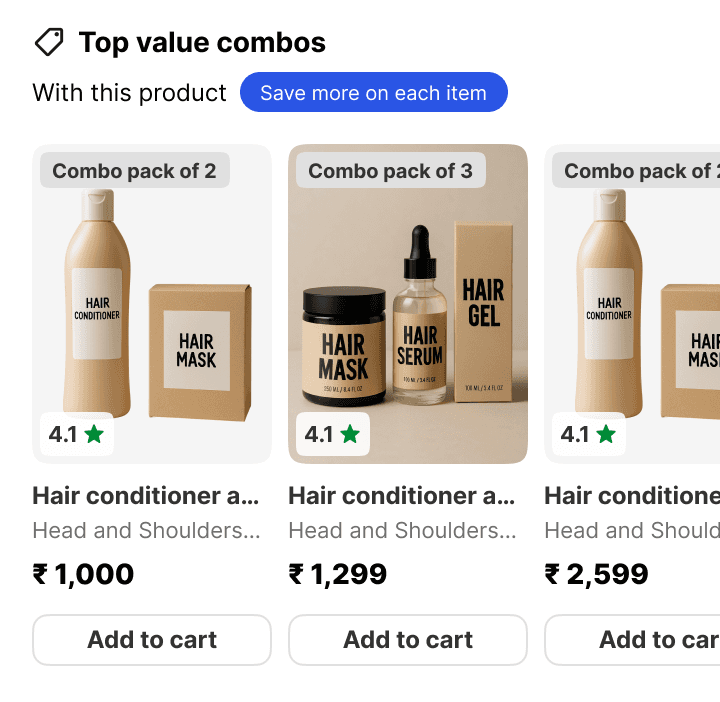
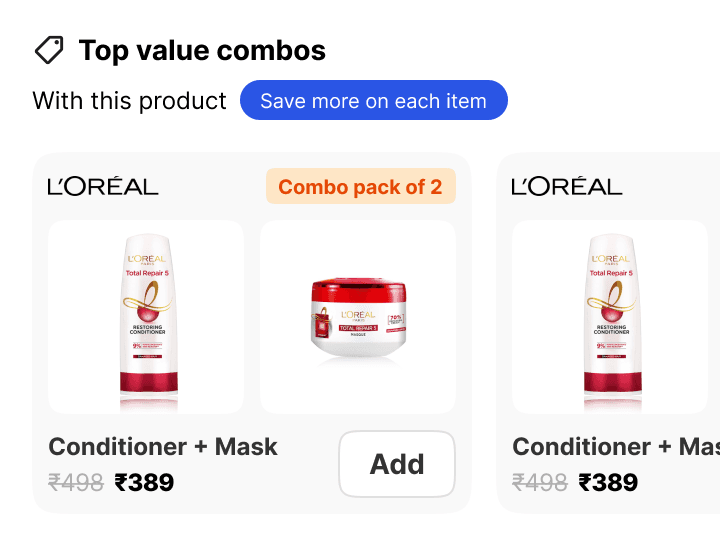
Routine based bundling and cross selling of products.
Products from categories like; skincare, haircare etc. are usually followed in a routine. Based on this hypothesis the system bundles relevant products together to make it easy for the customer to make an informed decision to not just purchase one product but by understanding the root cause, purchasing a bundle.
Routine based bundling
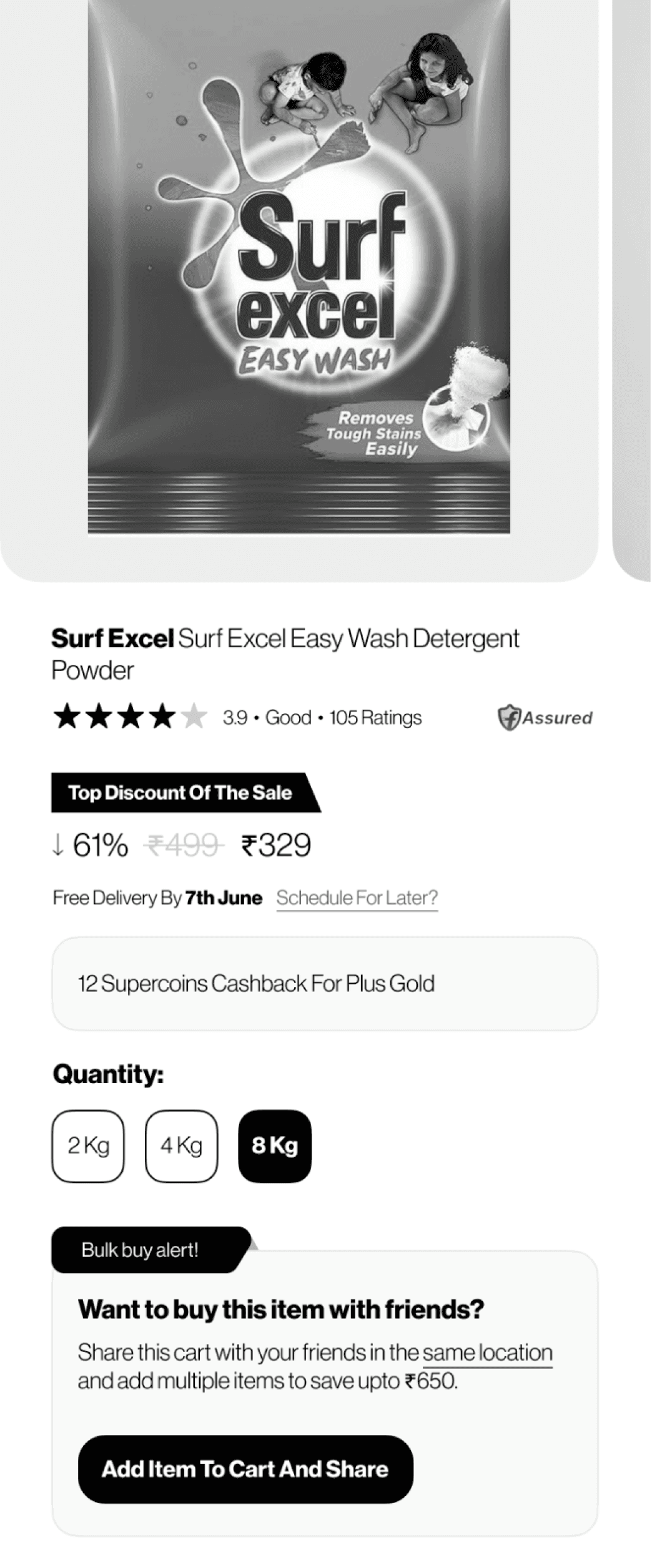
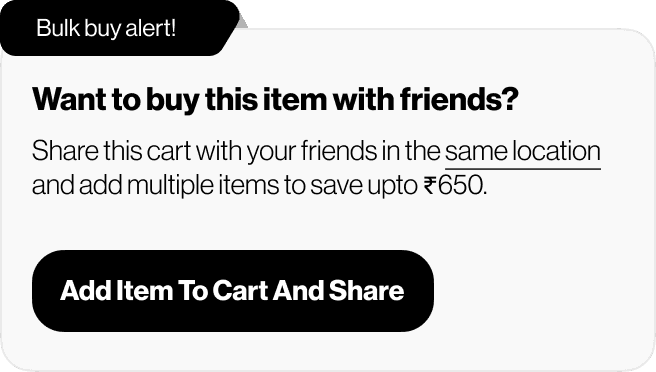
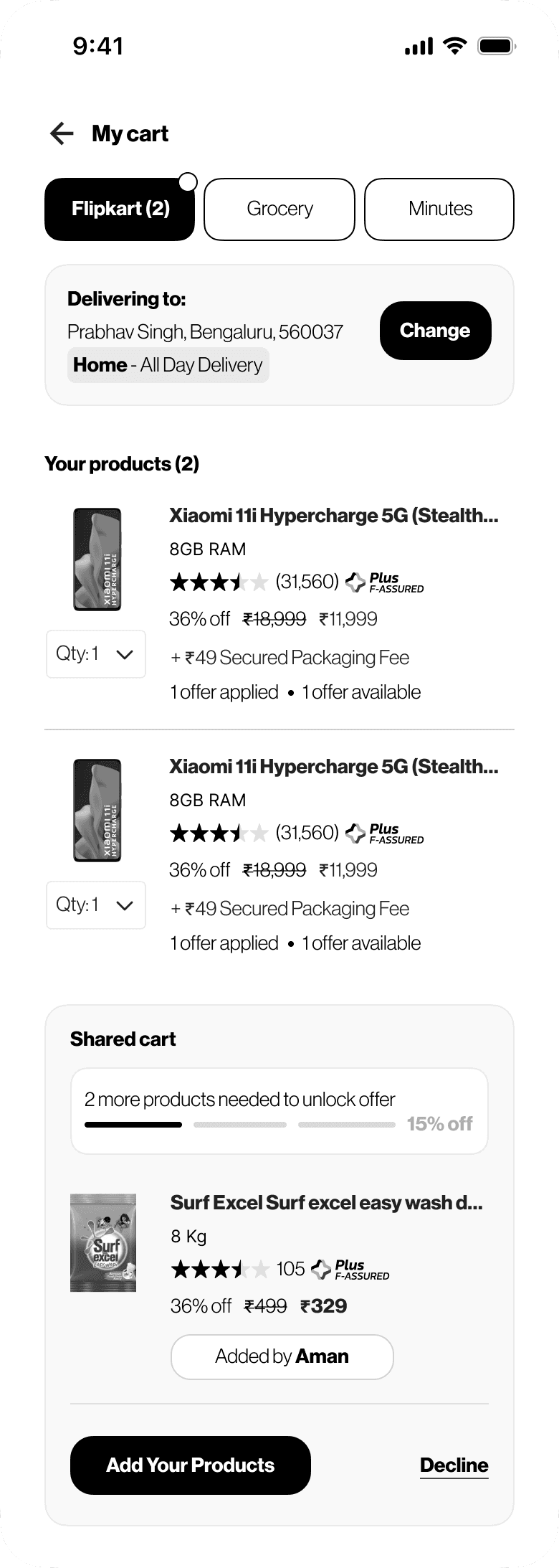
Share the cart with your trusted ones and get rid of redundant charges.
People can share their cart with their friends or family to let them add their desired products and cumulatively place the order from the primary user's account. This saves delivery charges and other small fee that gets added on low value orders.
Shared cart {Exploration}
Outcome & impact
This project was an internship exploration — designs were presented to the product team and leadership at Flipkart.
On phased testing, we found that the new designs were performing better by 48%. And because of that the U2O increased to 1.8 from 1.2.
Other work from this internship
Apart from my primary task, I picked up other challenges during my internship. I worked on an animation for the post payment state, an animated state for when the system hits a limit on payments and designed some icons for the product features.
Post Payment Animation
Designed the confirmation state animation for Flipkart's checkout flow.
Payment Limit (BBD)
Designed the payment cap UI for Big Billion Days, communicating transaction limits clearly under high-traffic conditions.
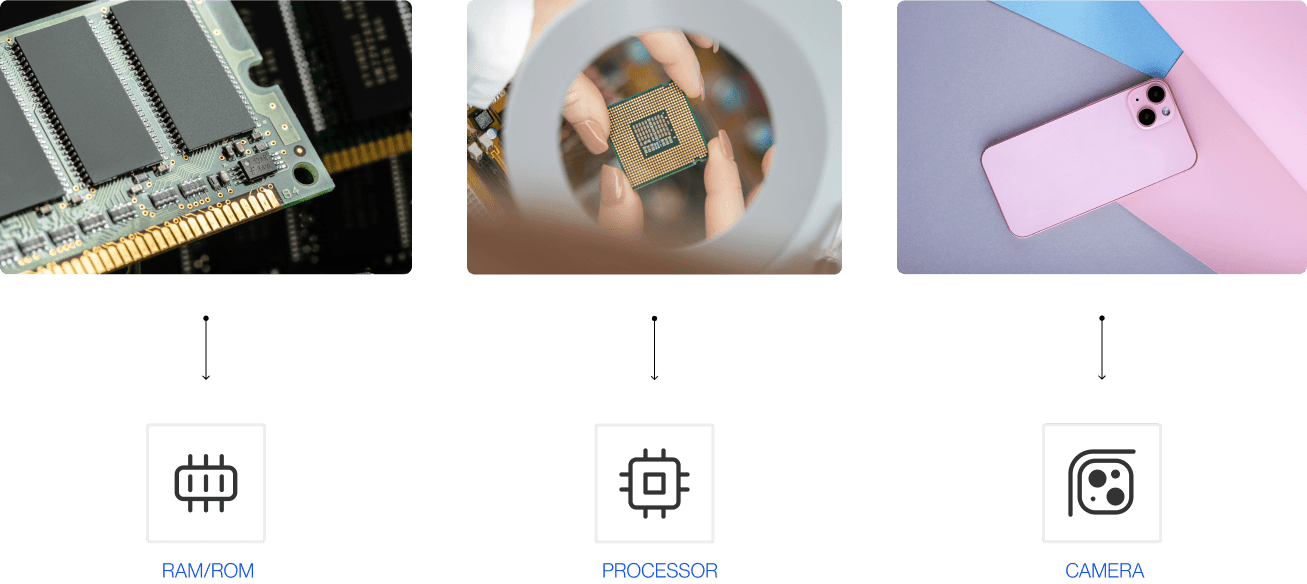
Product Features Icons
Created a scalable icon system for surfacing product feature callouts across categories.
© 2026 Prabhav Singh • All rights reserved