WHO
Lopez
2025
Restoring balance
Designing one visual system across physical ceremonies, experiential space, and a global digital platform, for the world's largest gathering on Traditional Medicine.
Industry
Healthcare
My role
Experience designer
Platform
Web portal + mobile
Outcome
3B+
Media reach (impressions)
100+
Countries represented
15K+
Online attendees via microsite
6
Halls with stage graphics I designed
Context & the problem
What is this?
The Second WHO Global Summit on Traditional Medicine convened at Bharat Mandapam, New Delhi, bringing together 1,200+ in-person delegates from 100+ countries, 111 global health stakeholders, and 15,000+ online participants across five days. It was the largest gathering of its kind, anchored by a single ambition: to position Traditional Medicine as a scientifically grounded, globally viable pillar of health systems.
The design challenge was not just to make it look good. It was to make a complex, multi-actor, multilingual, multi-venue summit feel like one coherent thing — from the moment a delegate saw a social post to the moment they walked through a ceremonial hall, clicked through a live-streamed session, and picked up a piece of merchandise.
The visual system needed to carry equal weight in six parallel halls, on a 154-foot curved cinematic screen, on a mobile phone, and on a jute bag. That is a range of context that very few design projects ever demand.
Challenge
Traditional Medicine is not an alternative. It is a foundation. The design had to communicate this without being defensive, through visual authority, not argument. Balance had to feel like a measurable principle, not a metaphor.`
Role & constraints
My work spanned the Summit, the WHO Discovery Experience (Expo), and the AYUSH Pavilion three interconnected environments that together constituted the full event footprint. Within that scope, I owned specific workstreams rather than contributing to everything equally.`
My role
{Designer} : Owned the digital presence experience of WHO and large scale print collaterals.
Team
Whole Lopez studio
Timeline
2 months {Mid October - Mid December}
Constraints
Timeline was a major constraint. There were multiple stakeholder parties involved throughout the process. Us, the WHO team, interiors team, logistics, printing etc. Maintaining the right communications across all of them was a major challenge.
Defining the direction
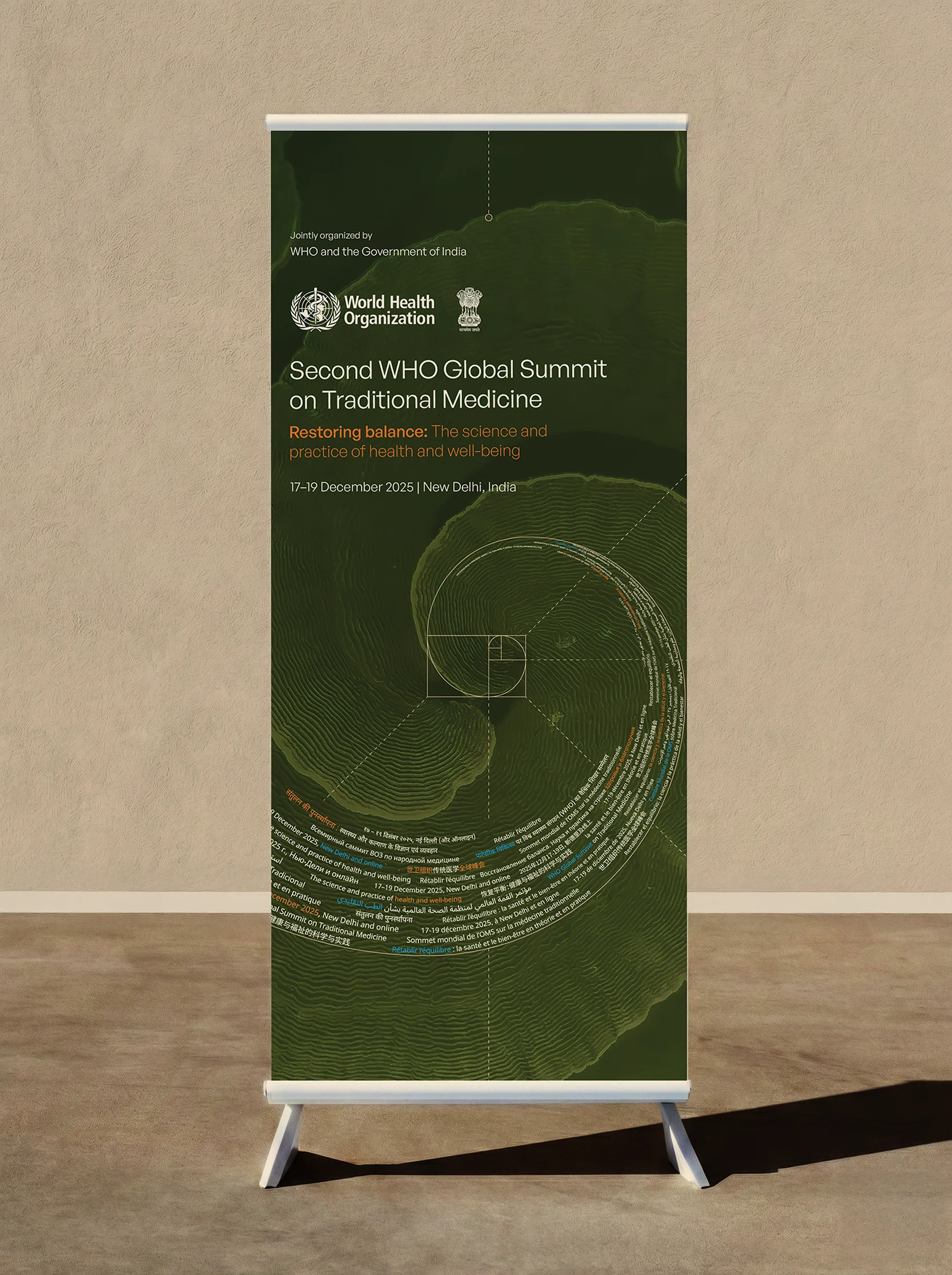
The Fibonacci spiral as a design system
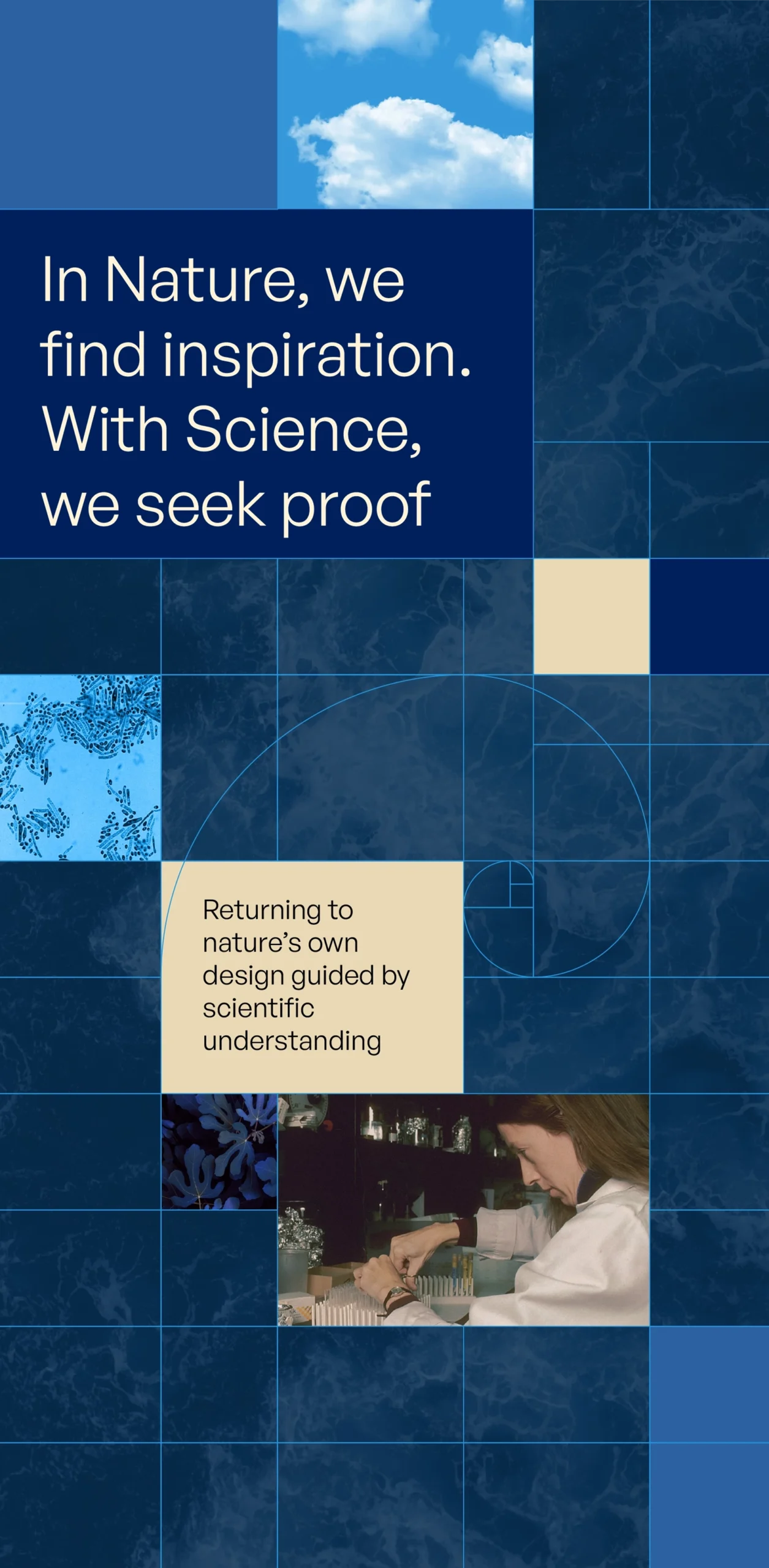
The summit's central narrative — Restoring Balance — needed a structural visual anchor, not just a theme. The Fibonacci spiral was chosen because it is not decorative. It is a naturally occurring mathematical principle that describes growth, proportion, and balance across biological and cosmic systems — the nautilus shell, a galaxy, a fern unfurling.
Applied to a summit about Traditional Medicine, it made the argument visually: nature and science are not opposites. The logarithmic spiral is living proof. This gave every deliverable — from the microsite header to the plenary hall backdrop — a shared underlying logic that scaled across contexts without repeating itself.
Additive
Principle 1
Each step builds on the previous one — holistic, cumulative, never subtractive. Mirroring how Traditional Medicine has evolved over centuries.
Scalable
Principle 2
The ratio holds at any size. A design system built on Fibonacci geometry is inherently proportionally correct from 6 inches to 60 feet.
Restrained palette
Principle 2
Nature-led: deep greens, warm ambers, earth tones. Not a brand colour. A language drawn from the subject itself — used consistently across physical, digital, and broadcast.
Design rationale
The identity system had to scale across physical, digital, broadcast, and experiential layers without losing coherence. The Fibonacci spiral gave us a structural principle, not just a motif, which is why it held at every scale.
Design
01
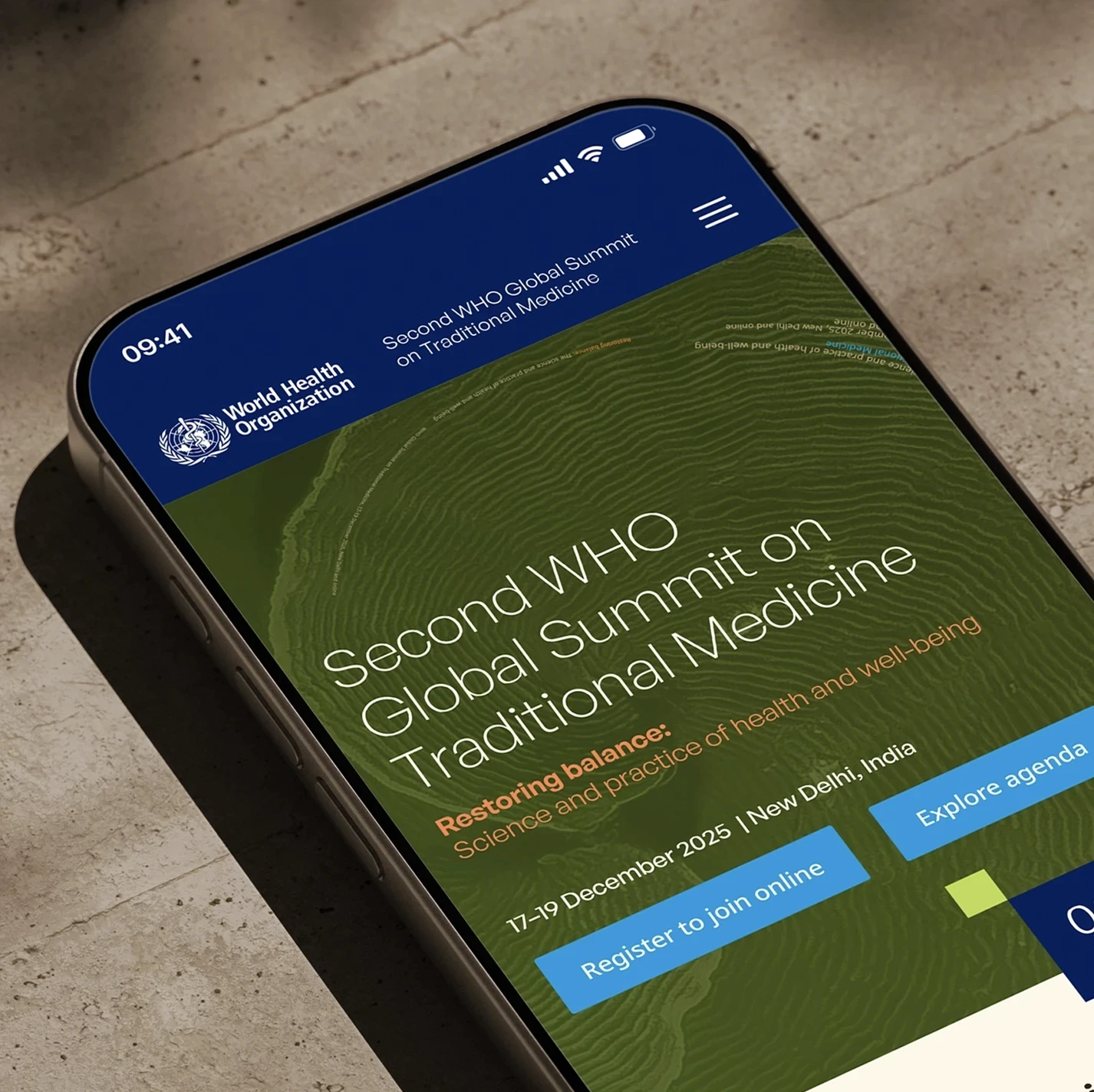
Digital Experience: A single point of entry for the world
The microsite was the global front door — 15,000+ online participants across 100+ countries, all of whom experienced the summit primarily through this platform. My role covered the entire digital stack: information architecture, UX flows, UI design system, and the logic for each functional mode the site operated in across a 4-stage rollout.
The site wasn't a static event page. It had to function as a live-streaming hub, a public survey tool, a mini-event interface, a Q&A platform, and an on-demand archive — sometimes simultaneously. Each mode required its own interaction logic, while the overall experience needed to feel continuous and unhurried.
4-stage rollout architecture
Principle 1
Pre-summit awareness → registration → live experience → post-event archive. Each stage surfaced different content priorities and CTAs without rebuilding the navigation structure.
Multilingual system (7 languages)
Principle 2
All 6 official WHO languages plus Hindi. Designed a modular layout system where text-heavy components could expand or contract without breaking hierarchy or obscuring key actions — essential for Arabic and French which expand significantly versus English.
Live-streaming interface
Principle 3
Designed the viewing experience to surface session context — speakers, simultaneous translation options, Q&A entry — without competing with the primary content. Kept the secondary UI invisible until needed.
Institutional credibility + human accessibility
Principle 4
Two very different audiences — policymakers and general public — on the same URL. The visual language used WHO's institutional weight while the interaction design prioritised discoverability and reduced friction for first-time users.
Visual continuity with physical experience
Principle 5
The microsite carried the Fibonacci geometry, nature-led palette, and editorial typographic structure from the physical identity — ensuring participants who attended in-person and online shared the same visual world.
02
Stage graphics across six halls
I envisioned and created all stage graphics across 2 plenary halls and 4 parallel halls — for both the opening and closing ceremonies. These were not supplementary visuals. They were the primary visual environment for every dignitary, practitioner, scientist, and delegate who walked onto or sat facing a stage at this summit.
The closing ceremony was attended by Prime Minister Narendra Modi and WHO Director-General Dr Tedros Adhanom Ghebreyesus, and broadcast live to a global audience. The stage graphics I designed were in the frame for every key moment — every policy announcement, every cultural performance, every handshake.
Plenary Hall 1
Main stage for opening and closing ceremonies. Broadcast-facing, attended by PM Modi and WHO DG. Highest visual stakes.
Hall 2
Secondary plenary, primary venue for keynote speakers and global delegation addresses throughout the 5-day summit.
Parallel Hall 1
Breakout sessions on policy frameworks and inter-governmental working groups.
Hall 2
Scientific research sessions and evidence-based practice showcases.
Hall 3
Indigenous knowledge exchange, designed to feel culturally grounded and humanised, distinct from the primary institutional register.
Hall 4
Innovation and future systems, a more forward-looking visual tone within the same design system.
03
The WHO discovery experience
The WHO Discovery Experience was a 55,000+ sq ft experiential environment across Bharat Mandapam, a spatial journey from ancestral knowledge systems through contemporary research to future health frameworks. My contribution was the wall design for the Convergence zone: the Global Tea Experience.
This zone had a specific behavioural purpose: to slow visitors down. After moving through the high-information environments of the timeline wall and narrative realms, the Tea Bar was designed as a moment of sensory rest. The transition from learning to feeling. From reading to tasting. From data to ritual.
Wall as atmosphere
Unlike other zones in the Expo which carried dense content, the Tea Bar wall was intentionally sparse, evoking stillness, natural texture, and warmth rather than communicating facts. The visual load was reduced so the space could breathe.
Material language
The design referenced the organic materiality of the zone, woven textures, earth tones, the quality of light through natural fibres, translating into the graphic vocabulary of the wall surface.
Cultural grounding
Tea as a ritual crosses almost every culture represented at the summit. The wall design acknowledged this without being literal, finding a register that felt universal rather than specific.
04
AYUSH Pavilion: India's traditional medicine systems
The AYUSH Pavilion presented India's traditional medicine systems — Ayurveda, Yoga, Unani, Siddha, Homeopathy — in dialogue with the global summit agenda. I contributed as part of the core team, supporting the visual and spatial design system as it extended into this third major environment.
PM Modi's closing announcements, including the My Ayush Integrated Services Portal and the Ayush Mark as a global quality benchmark, gave this pavilion additional significance as the physical staging ground for India's formal commitments to Traditional Medicine at a global level.
Outcome & impact
3B+
Total impressions across broadcast and media coverage.
783k
Social creatives and system-consistent content distributed across platforms.
15k+
Global participants accessed the summit through the digital experience I designed.
6
2 plenary + 4 parallel halls. Every delegate, speaker, and dignitary spoke on stages I designed.
188K
Across the 4-stage rollout from pre-summit awareness through post-event archive.
100+
The design system served delegations from over 100 countries, across languages, cultures, and professional contexts.
© 2026 Prabhav Singh • All rights reserved